

2025 Federal Crime Sentencing Report
Federal convictions dropped 18% in 5 years, but sentences have grown longer—and where you're prosecuted matters more than ever.
 Last Updated on Dec 09, 2025
Key insights
- Immigration and drug trafficking dominate federal convictions: Together, these two crime categories accounted for 60% of all federal convictions in 2024 (30% each).
- 91% of federal offenders are sentenced to prison, far harsher than most state systems.
- Federal convictions declined 18% since 2019, but crime sentence lengths rose 33%: kidnapping sentences increased 30%, sexual abuse 17%, and assault 28% over five years.
- Drug trafficking sentences in Iowa average 12.8 years—nearly five times longer than Arizona’s 2.7 years: Geographic disparities in sentencing are stark, with Iowa imposing the nation’s longest average sentences for both drug offenses and crimes against persons.
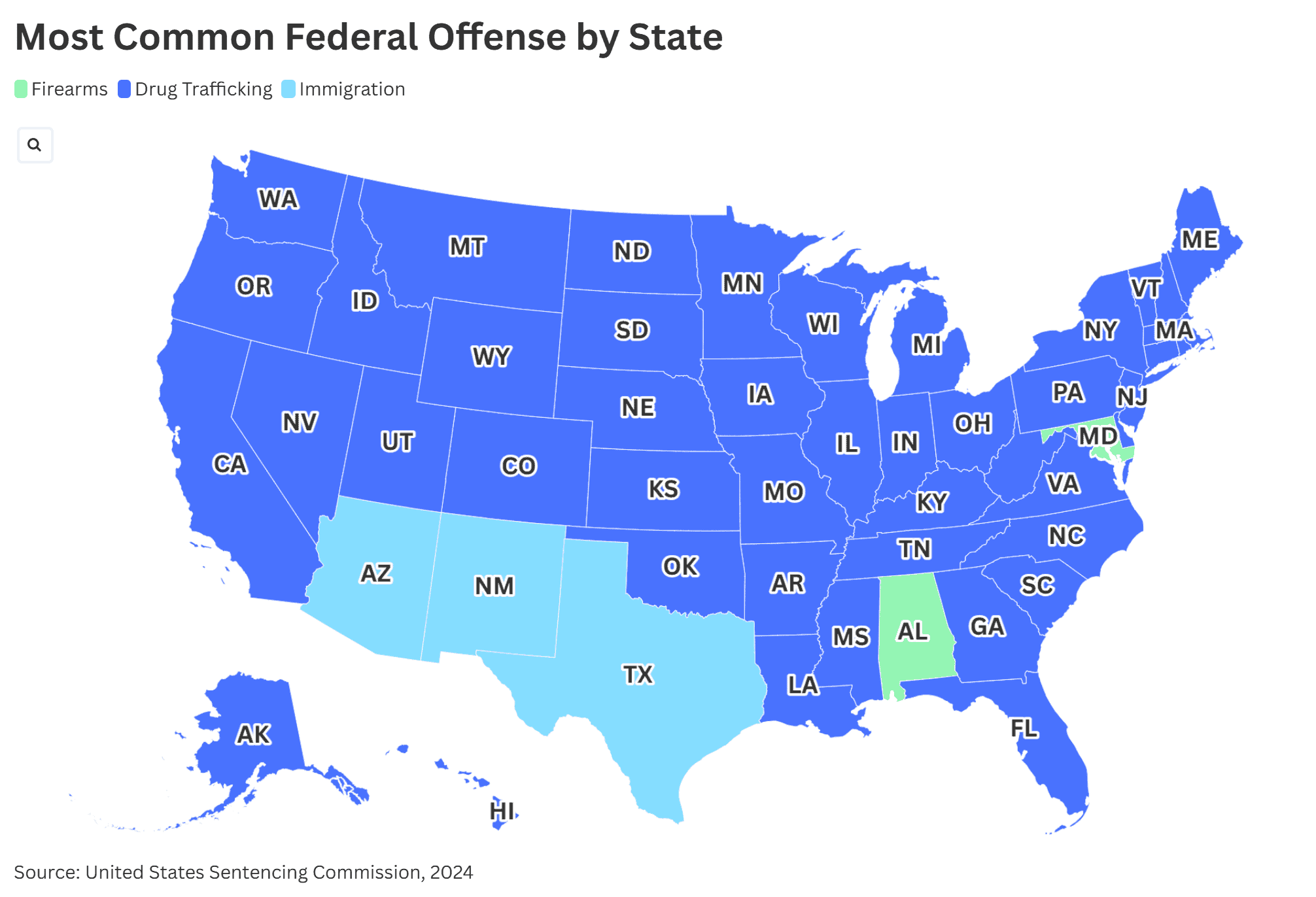
- Border states prioritize immigration prosecutions while interior states focus on drugs: Immigration offenses made up 67-72% of federal sentences in Texas, Arizona, and New Mexico, while drug trafficking was the top federal crime in 45 other states.
- Alabama and Maryland were the only two states where gun crimes—rather than drugs or immigration—represented the most common federal conviction, with firearms accounting for 32% and 24% of sentences, respectively.
Understanding how the federal justice system responds to crime is essential for anyone concerned about personal and community safety. Sentencing patterns influence everything from where law enforcement allocates resources to how courts weigh the severity of different criminal behaviors. At Security.org, our goal is to break down these patterns in clear and accessible terms, so our readers can make informed decisions about how to keep their homes and families safe, regardless of where they live.
To uncover the latest trends, we analyzed the United States Sentencing Commission’s (USSC) Federal Sentencing Statistics, which provide a detailed look at federal convictions, sentence lengths, and crime distribution across all 50 states. The data helps us understand not just what crimes come before federal courts most often, but how the severity of punishment varies depending on where the offense occurs.
The Most Common Federal Crimes in 2025
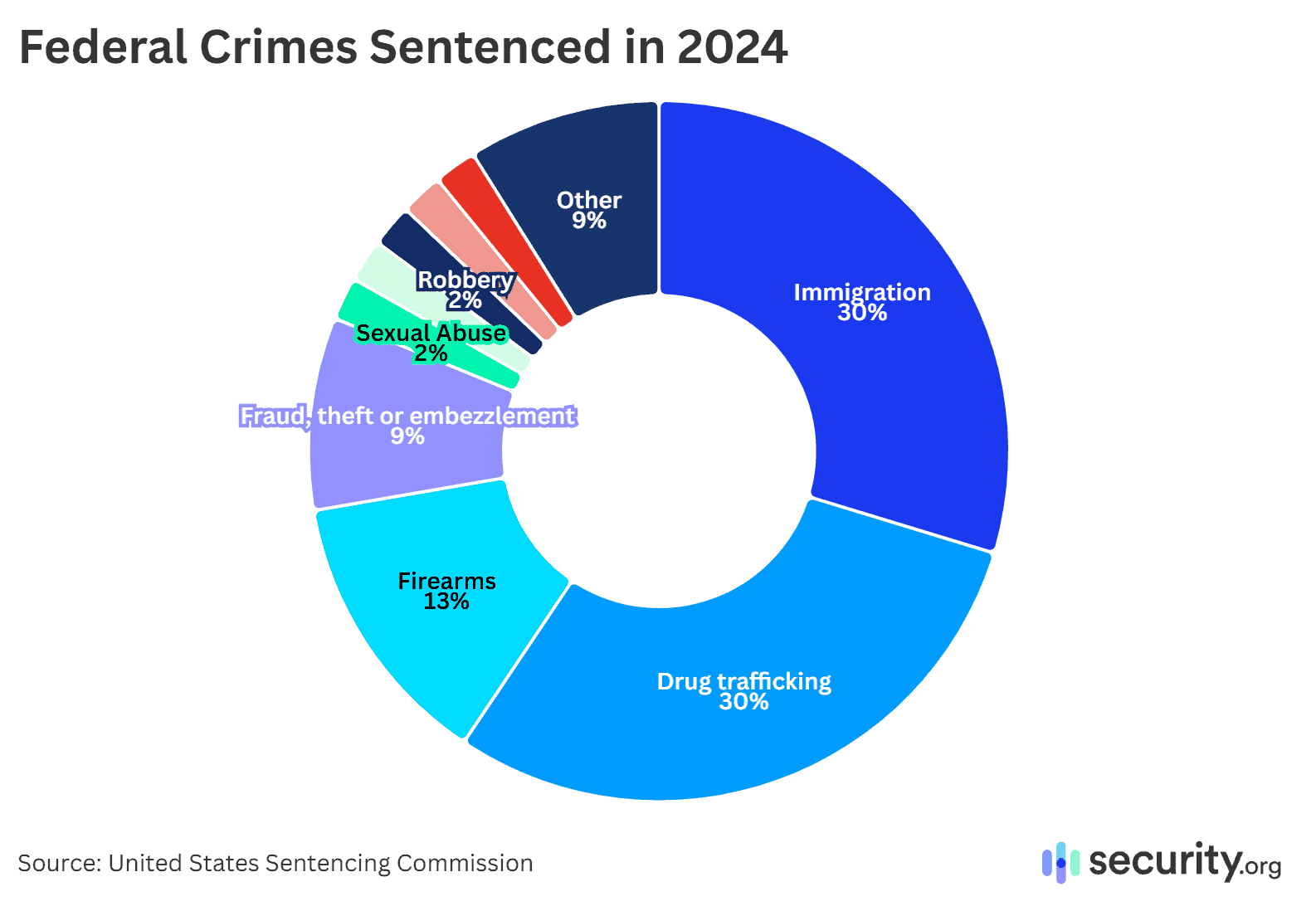
Federal courts handed down 61,678 sentences for crimes in 2024, and an overwhelming 91% of them involved incarceration as the punishment. That makes federal sentencing significantly harsher than most state systems, where probation or fines are more common.
Immigration-related offenses and drug trafficking crimes dominated the federal docket. Immigration and drug trafficking offenses each made up 30 percent of all federal convictions. This makes sense since issues pertaining to immigration and interstate commerce, both legal and illegal, are handled by the federal government rather than state governments.
How Federal Criminal Offenses Changed from 2019 to 2024
| Crime or offense | Percent of sentences in 2024 | Number of sentences in 2024 | Percent change 2019-2024 |
|---|---|---|---|
| All federal crimes | 100% | 61,678 | -18% |
| Immigration | 30% | 18,492 | -37% |
| Drug trafficking | 30% | 18,172 | -6% |
| Firearms | 13% | 8,131 | -1% |
| Fraud, theft, or embezzlement | 9% | 5,312 | -16% |
| Sexual abuse | 2% | 1,430 | 25% |
| Child pornography | 2% | 1,375 | 1% |
| Robbery | 2% | 1,323 | -24% |
| Money laundering | 2% | 1,289 | 12% |
| Assault | 2% | 901 | 14% |
| Other | 1% | 871 | -16% |
| Administration of justice | 1% | 660 | -4% |
| Murder | 1% | 523 | 50% |
| Tax | 1% | 440 | -20% |
| Prison offenses | 1% | 438 | -30% |
| Bribery or corruption | 1% | 362 | 7% |
| Obscenity or other sexual offenses | 1% | 339 | -14% |
| Stalking or harassing | 0.4% | 254 | 14% |
| National defense | 0.4% | 229 | 17% |
| Kidnapping | 0.2% | 147 | 53% |
| Environmental | 0.2% | 140 | -22% |
| Individual rights | 0.2% | 125 | 81% |
| Extortion or racketeering | 0.2% | 112 | -39% |
| Manslaughter | 0.2% | 111 | 50% |
| Drug possession | 0.2% | 109 | -81% |
| Burglary or trespass | 0.2% | 99 | 57% |
| Forgery, counterfeit, or copyright | 0.2% | 95 | -66% |
| Arson | 0.1% | 84 | 24% |
| Commercialized vice | 0.1% | 72 | -20% |
| Food and drug | 0.1% | 35 | -22% |
| Antitrust | 0.0% | 8 | -60% |
Immigration convictions dropped sharply compared to 2019, partly due to recent executive actions emphasizing civil penalties and streamlined removals rather than criminal prosecution. Drug trafficking numbers remained stable, revealing that federal authorities continue to treat large-scale drug distribution as a priority even as states relax laws around personal drug possession. White-collar and financial crimes, such as fraud and embezzlement, declined, mirroring a multi-year trend. Despite making up a smaller share of overall cases, the sentencing of violent crimes such as murder, kidnapping, and sexual abuse increased significantly.
Punishments for Federal Crimes
| Sentences for federal convictions | Percentage of sentences in 2024 |
|---|---|
| Prison only | 89% |
| Prison and alternative | 2% |
| Probation only | 7% |
| Probation and alternatives | 1% |
| Fine only | 0% |
Though there was a decline in total sentences over the past five years, prison remains the dominant outcome for most federal offenders. Nine in ten federal convicts end up behind bars, reflecting the continued dominance of incarceration in federal sentencing. In 97 percent of cases, people accepted plea deals, and just three percent went to trial in 2024.
Federal Sentencing Trends Over Time
While the number of federal cases has decreased since 2019, the severity of sentences has moved in the opposite direction. Violent crime sentences in particular rose sharply: the median federal term for these offenses increased 12 percent over the past five years. Crimes such as kidnapping and sexual abuse carry some of the longest sentences in the federal system, and the recent data shows that those punishments grew even more severe.
The federal system also continues to impose long sentences for drug trafficking. Although the length of these sentences has remained relatively stable, they consistently rank among the harshest, except for those related to violent crimes. In contrast, white-collar crimes witnessed a continued decline in penalty severity, reinforcing a judicial trend toward more skepticism of extremely long prison terms for financial offenses.
Changes in Federal Crime Sentencing, 2019-2024
| Offense | 2024 median sentence length | Change in sentence length (in months) since 2019 |
|---|---|---|
| Murder | 20 years | No change |
| Sexual abuse | 17.5 years | +2.5 years |
| Kidnapping | 13 years | +3 years |
| Child pornography | 8.1 years | +1.1 years |
| Robbery | 8 years | +4 months |
| Drug trafficking | 5.25 years | +3 months |
| Arson | 5 years | No change |
| Manslaughter | 5 years | No change |
| Assault | 3.8 years | +10 months |
| Firearms | 3.3 years | +1 month |
| Money laundering | 2.3 years | -5 months |
| Individual rights | 2 years | +1.8 years |
| Stalking or harassing | 2 years | No change |
| Extortion or racketeering | 1.5 years | No change |
| National defense | 1.5 years | -6 months |
| Obscenity or other sex offenses | 1.5 years | -9 months |
| Commercialized vice | 1.1 years | -7 months |
| Bribery or corruption | 1 years | +4 months |
| Forgery, counterfeit, or copyright | 1 years | No change |
| Fraud, theft, or embezzlement | 1 years | No change |
| Prison offenses | 1 years | No change |
| Tax | 10 months | -2 months |
| Administration of justice | 8 months | No change |
| Immigration | 7 months | +1 month |
| Burglary or trespass | 3 months | -11 months |
Between 2019 and 2024, sentence lengths for sexual abuse offenses increased by 17 percent, kidnapping by 30 percent, and assault by 28 percent, according to the USSC data. Drug-related sentences also ticked upward by five percent, though that’s modest compared to the rise for violent crimes. Meanwhile, declines in sentence length for commercialized vice, tax crimes, and extortion show that not all federal categories follow the same trajectory.
One notable outlier in the data is “individual rights” offenses, which saw a staggering increase in median sentence length, nearly doubling from two years to 3.8 years. While this category is very small, it may reflect a handful of serious crimes involving civil rights violations, human trafficking, or hate crimes that resulted in exceptionally long sentences.
These shifts also align with prominent federal cases in the news. In Tennessee, a man previously charged in connection with the January 6 Capitol riot was convicted in 2024 of plotting to kill FBI investigators — a case that could result in a life sentence. In Illinois, an Indiana resident tied to a cartel-linked drug and money-laundering ring was arrested in a DEA-led sting. Both of these high-profile cases highlight the federal government’s renewed focus on violent and organized crime networks.
Top Federal Crimes by State
Although the overall national numbers tell an interesting story, the federal criminal landscape appears very different when examined state by state. Drug trafficking was the most commonly prosecuted federal crime in 45 states. The exceptions were the key Southwest border states—Texas, Arizona, and New Mexico—where immigration offenses were the most prevalent. In Texas, for instance, 67 percent of all federal sentences in 2024 were related to immigration crimes, reflecting the state’s prominent location for unlawful border crossings.
| State | Most common federal offense | Percentage of all crimes sentenced in 2024 |
|---|---|---|
| Alabama | Firearms | 32% |
| Alaska | Drug trafficking | 42% |
| Arizona | Immigration | 72% |
| Arkansas | Drug trafficking | 40% |
| California | Drug trafficking | 42% |
| Colorado | Drug trafficking | 31% |
| Connecticut | Drug trafficking | 45% |
| Delaware | Drug trafficking | 34% |
| District of Columbia | Administration of justice | 20% |
| Florida | Drug trafficking | 29% |
| Georgia | Drug trafficking | 38% |
| Hawaii | Drug trafficking | 69% |
| Idaho | Drug trafficking | 48% |
| Illinois | Drug trafficking | 34% |
| Indiana | Drug trafficking | 40% |
| Iowa | Drug trafficking | 41% |
| Kansas | Drug trafficking | 32% |
| Kentucky | Drug trafficking | 49% |
| Lousiana | Drug trafficking | 32% |
| Maine | Drug trafficking | 31% |
| Maryland | Firearms | 24% |
| Massachusetts | Drug trafficking | 38% |
| Michigan | Drug trafficking | 29% |
| Minnesota | Drug trafficking | 42% |
| Mississippi | Drug trafficking | 32% |
| Missouri | Drug trafficking | 36% |
| Montana | Drug trafficking | 43% |
| Nebraska | Drug trafficking | 45% |
| Nevada | Drug trafficking | 25% |
| New Hampshire | Drug trafficking | 46% |
| New Jersey | Drug trafficking | 39% |
| New Mexico | Immigration | 69% |
| New York | Drug trafficking | 28% |
| North Carolina | Drug trafficking | 34% |
| North Dakota | Drug trafficking | 55% |
| Ohio | Drug trafficking | 42% |
| Oklahoma | Drug trafficking | 27% |
| Oregon | Drug trafficking | 56% |
| Pennsylvania | Drug trafficking | 43% |
| Rhode Island | Drug trafficking | 44% |
| South Carolina | Drug trafficking | 41% |
| South Dakota | Drug trafficking | 29% |
| Tennessee | Drug trafficking | 43% |
| Texas | Immigration | 67% |
| Utah | Drug trafficking | 36% |
| Vermont | Drug trafficking | 41% |
| Virginia | Drug trafficking | 31% |
| Washington | Drug trafficking | 36% |
| West Virginia | Drug trafficking | 58% |
| Wisconsin | Drug trafficking | 36% |
| Wyoming | Drug trafficking | 35% |
In states far from the border, drug trafficking cases often reflect federal task force efforts targeting distribution networks operating along interstate corridors. This is especially visible in places like Kentucky, Tennessee, Indiana, and Missouri, where prosecutors frequently pursue trafficking cases tied to fentanyl or methamphetamine distribution across state lines. Firearms offenses emerged as the top federal crime in only two states—Alabama and Maryland.
Federal Sentence Lengths by State: The Geography of Punishment
One of the most striking findings from the 2025 data is the vast disparity in sentence lengths across states. Even for the same types of crime, offenders in certain states receive significantly longer prison terms than those elsewhere.

Longest drug offense sentences
| Rank | State | Average drug crime sentences in years |
|---|---|---|
| 1 | Iowa | 12.8 |
| 2 | South Dakota | 12.0 |
| 3 | Indiana | 10.1 |
| 4 | Nebraska | 9.9 |
| 5 | Mississippi | 9.7 |
Note: Ranking only includes states with 30+ sentences in 2024
Sentences for drug offenses, which include trafficking and possession, vary widely across the country. Among states with 30 or more sentences in 2024, the average lengths ranged from 2.7 years in Vermont and Arizona to 12.8 years in Iowa. Midwest states like Iowa and Nebraska may have longer average sentences due to the types of drug crimes that happen in the region. For example, fentanyl or methamphetamine distribution offenses that cross state lines tend to carry harsher penalties than simple marijuana possession.
Longest crimes against persons sentences
| Rank | State | Average sentence for crimes against persons in years |
|---|---|---|
| 1 | Iowa | 17.2 |
| 2 | Maryland | 15.9 |
| 3 | Indiana | 15.8 |
| 4 | Virginia | 15.1 |
| 5 | Kentucky | 14.6 |
Note: Ranking only includes states with 30+ sentences in 2024
Interestingly, crimes against persons (a category including violent offenses like murder, kidnapping, sexual abuse, robbery, and child pornography offenses) see enormous variation depending on the state. Again Iowa’s average sentence was the nation’s longest, at 15.8 years. Sentences in Maryland, Indiana, and Virginia also averaged over 15 years. Nevada was at the other end of the spectrum, with sentences just 6.3 years in length on average.
Longest white-collar crime sentences
| Rank | State | Average white collar crime sentences in years |
|---|---|---|
| 1 | Tennessee | 4.1 |
| 2 | Indiana | 3.5 |
| 3 | Kentucky | 3.3 |
| 4 | Colorado | 3.1 |
| 5 | Georgia | 2.9 |
Note: Ranking only includes states with 30+ sentences in 2024
White-collar crime sentencing shows only modest variation across the country; however, even within this category, some states stand out. White-collar crimes included offenses such as embezzlement, bribery, forgery, counterfeiting, money laundering, and environmental offenses. Tennessee imposes the longest average white-collar sentences at 4.1 years, followed by Indiana and Kentucky. Several states, like Maine, Idaho, and Rhode Island, had sentences of one year or less on average.
Longest immigration crime sentences
| Rank | State | Average immigration crime sentences in years |
|---|---|---|
| 1 | Colorado | 1.8 |
| 2 | North Carolina | 1.8 |
| 3 | Illinois | 1.7 |
| 4 | New Jersey | 1.7 |
| 5 | Kentucky | 1.2 |
Note: Ranking only includes states with 30+ sentences in 2024
When it came to immigration offenses, like unlawful entry, alien smuggling, or immigration fraud, the differences between states’ typical sentencing weren’t very stark. However, Colorado and North Carolina did have the longest average sentences for immigration offenders, at 1.8 years. Utah had the shortest sentences, at around six months.
Do Long Prison Sentences Make the Country More Secure?
The latest federal sentencing data makes one thing clear: sentences are getting longer, especially for violent and drug offenses. But are these prison sentences effective at reducing crime on our streets? The answer isn’t simple. USSC research has shown that people receiving sentences of five to ten years or more are less likely to re-offend than those receiving shorter sentences for federal crimes. However, the commission has also found that 49 percent of federal offenders are rearrested within eight years of release.
Interestingly, the National Institute of Justice has shared research that shows that long prison terms do little to deter crime and could actually increase recidivism. In fact, the chance of being caught for committing a crime is often a much more effective deterrent than even the harshest punishment.
Methodology and Data
For this project, we evaluated data from the United States Sentencing Commission’s (USSC) 2024 Federal Sentencing Statistics. The dataset presents sentencing statistics for various types of federal crimes across all U.S. states and outlying areas for fiscal year 2024 (Oct. 1, 2023 – Sept. 29, 2024). For consistency, we limited our analysis to the 50 U.S. states and the District of Columbia. National overviews and averages were derived from the national summary tables provided by the USSC.
To produce reliable estimates for ranking states by sentence lengths, we excluded states that sentenced fewer than 30 offenders within a given crime category from comparative analyses of sentencing percentages and imprisonment rates. Using a 30-case threshold helps ensure that each state’s averages and proportions reflect a meaningful volume of sentencing activity and are not overly influenced by outliers or rare events.
Crimes were grouped into four broad categories for analysis:
- Drug offenses: Drug possession and drug trafficking
- Immigration offenses: Immigration-only crimes such as unlawful entry
- Crimes against persons: Assault, kidnapping, manslaughter, murder, robbery, sexual abuse, stalking/harassment, child pornography, and other sexual or violent offenses
- White collar crimes: Financial, corporate, or deception-based crimes without direct violence, including antitrust, bribery/corruption, forgery/counterfeiting, fraud/theft/embezzlement, money laundering, tax, regulatory, environmental, and obstruction or perjury-related offenses